
Cost Guide
How Much Does Foundation Repair Cost in Colorado? (2026 Price Guide)
Real ranges for crack repair, piers, and replacement, what moves your number, and why the lowest bid usually costs the most in the end.
Foundation repair in Colorado can cost a few hundred dollars for a simple crack or north of $30,000 for a full replacement. Most structural repairs land between $5,000 and $20,000. Big spread, right? That is because the price tracks what is actually wrong, how deep the crew has to dig to fix it, and how long the house sat moving before anyone caught it. So let us walk through the real numbers, one repair at a time.
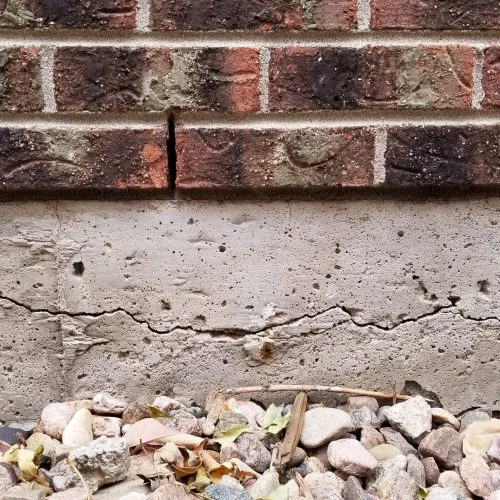
What Foundation Repair Costs in Colorado
Every house is its own puzzle, so read these as sanity-check ranges, not a quote. We run into them over and over, up and down the Front Range and all around Colorado Springs. The only number that ever really means anything is the one measured off your own foundation, in person.
| Repair | Typical Colorado cost | Best for |
|---|---|---|
| Epoxy or polyurethane crack injection | Under $1,000 per crack | Non-structural cracks and minor seepage |
| Helical or push piers | $1,200 to $3,500 per pier | A settling foundation |
| Typical pier project (4 to 12 piers) | $5,000 to $40,000 (most land $8,000 to $20,000) | Structural settlement |
| Wall anchors or braces | Priced per anchor | Bowing basement walls |
| Full foundation replacement (rare) | $30,000 and up | Widespread foundation failure |
Crack injection, the epoxy or polyurethane kind, usually runs under $1,000 per crack. Good for non-structural cracks and the little bit of seepage that tags along. Piers are a whole different animal. Helical and push piers are the permanent answer when a foundation is settling, and they run about $1,200 to $3,500 each, installed. Most jobs need 4 to 12. Multiply that out and a pier project lands anywhere from $5,000 to $40,000, with most homeowners somewhere in the $8,000 to $20,000 band. Bowing basement walls are their own thing, handled with wall anchors or braces and priced by the anchor. Full replacement? That is the rare one. When a foundation has basically quit along its whole length, you are looking at $30,000 and up.
What Drives the Price Up or Down
Two houses on the same street can get wildly different quotes, and it is almost never the contractor padding the bill. It is the engineering underneath the slab.
Depth to stable soil moves the needle more than anything. Piers have to punch past the active clay and hit ground that actually holds weight. Sometimes that is 10 feet down. Sometimes you are drilling to 25 or past it. The farther the steel travels, the bigger the bill. Then you have got how much of the foundation is actually affected, because a longer settling run eats more piers, generally one every 5 to 8 feet. Access is a factor people forget. Tight lot, finished basement, a deck sitting right over the work, piers that have to go in from inside the house, it all piles on labor hours. And do not skip the water. If bad drainage or blown waterproofing kicked off the movement in the first place, piering the foundation and ignoring the water just signs you up for round two later.

Crack Repair, Piers, or Replacement
This is where homeowners either save money or throw it away: matching the fix to what is genuinely wrong. A thin vertical crack? Often just concrete that cured and shrank, and it seals up for a few hundred bucks. But a wall bowing inward, or a floor that has started to tilt, that is a load problem, and now you are into piers or anchors. Replacement only comes up when the foundation has failed just about everywhere at once, and that is not something we run into often.
Want the deeper numbers on the structural side? Our guide to helical pier pricing breaks down per-pier cost and how we arrive at pier count, and our Colorado Springs cost breakdown lines up crack repair, waterproofing, and replacement next to each other. When you are ready for the repair itself, start at our foundation repair page and read up on the signs of foundation settlement.

Why Colorado Soil Sets the Price
Colorado homes do not crack by bad luck. Blame the dirt. Most of the Front Range sits on expansive clay, the kind that puffs up fat when it gets wet and shrinks back down when it dries out. Every one of those swings heaves and drops the soil under your footings, and your foundation has no choice but to ride along. Now add the freeze-thaw we get up at this altitude, toss in a drought year or two, and the result is a slow grind that pries cracks open and tips walls off plumb. It is the whole reason the same repair tends to cost more here than it would on calm, boring, stable ground somewhere else. Our piers are chasing a target that keeps moving, so they go deeper and bunch up tighter. Anybody hunting for foundation repair in Colorado Springs or Denver foundation repair is wrestling the exact same clay, just on opposite ends of the metro.
Waiting Is the Expensive Choice
Foundation movement does not heal itself. The soil just keeps cycling, the damage keeps creeping outward, and the bill climbs right along with it. A wall that takes 6 piers this year might want 10 the next, and now you are also paying for drywall, a window that sticks, and a plumbing line that got yanked out of true. We watch $6,000 repairs balloon into $20,000 repairs all the time, and the only thing that changed was the calendar. That is the honest cost of sitting on it. If the price tag is the thing holding you back, 0% financing on approved credit breaks it into a monthly payment so the work gets done while the problem is still small.
How to Compare Quotes Without Overpaying
That rock-bottom bid? Nine times out of ten it quoted the fewest piers at the shallowest depth, which is precisely the fix that gives out in a few years. So judge quotes on the engineering, not the number stapled to the bottom. How many piers. To what depth or load rating. What the warranty actually covers, and whether it follows the house to the next owner. A company that cannot tell you why its pier count is right is guessing with your home on the line. Our list of questions to ask a foundation repair company hands you the script word for word.
The honest way to learn your real number is a free inspection. You walk away with a fixed price in writing, a straight answer on whether the problem is structural or just cosmetic, and nobody leaning on you to sign. Plenty of our visits end with us telling the homeowner the house is fine for now. We would rather say that than sell you piers you do not need. Call us at (719) 497-1388.