
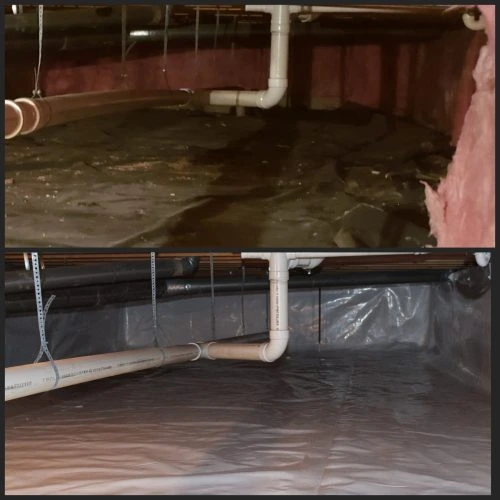
Crawlspace Encapsulation: Conditioned, Sealed Crawlspaces for Colorado Homes
Encapsulation converts a vented dirt crawlspace into a sealed, conditioned space using a reinforced vapor barrier, sealed vents and penetrations, foam-board wall insulation, and humidity control. Done correctly, it eliminates moisture, mold, and rim-joist heat loss permanently.
Free inspection • Exact price in writing • 0% financing on approved credit
Quick Answer
We seal the ground with a 20-mil reinforced barrier, run it up the walls and tape the seams, close the vents, insulate the rim and walls with code-compliant rigid foam, and add a dehumidifier sized to the volume. The crawlspace ends up dry, conditioned, and code-compliant under IRC R408.3 (unvented crawlspaces).
A vented crawlspace was conceived in a humid climate as a way to dilute ground moisture with outside air. In Colorado that logic mostly fails. Our summer dew points routinely exceed crawlspace surface temperatures, which means outside air vented into a cool crawlspace condenses on every surface it touches — floor joists, ductwork, insulation batts. The longer the vents stay open in monsoon season, the wetter the assembly becomes. Encapsulation reverses this by making the crawlspace part of the conditioned building envelope, governed by the same humidity and temperature the rest of the house enjoys.
A correctly engineered encapsulation does five things simultaneously: it isolates soil moisture from the air with a continuous vapor barrier; it removes the air-leakage pathway by sealing vents and penetrations; it brings the foundation walls inside the thermal envelope with rigid insulation against the concrete or block; it manages residual moisture with a dehumidifier or a small supply of conditioned air from the HVAC system; and it preserves access for plumbing, electrical, and pest inspection.
Done correctly, the payoff lands across the whole house: lower humidity in the living space (the "stack effect" pulls 30-50% of first-floor air from below), warmer floors in winter, less ductwork condensation, and an end to the musty smell that pre-encapsulated crawlspaces broadcast into bedrooms above. It is also a structural moisture intervention — framing members that stay below 16% moisture content don't support mold growth and don't decay.
Why Vented Crawlspaces Fail in Colorado
On a typical July afternoon the Front Range sees 75°F outside air at 60% RH — a dew point near 60°F. A crawlspace floor that sits at 58°F is below that dew point. Every cubic foot of vented air that reaches the crawlspace deposits liquid water on the coldest surface it touches. Compound that across three monsoon months and the result is fiberglass batts saturated to the point of falling out of the joist bays, blackened sheathing on the underside of the subfloor, and active mold on every wood surface. Encapsulation breaks the cycle by removing the air exchange entirely.
The Full Encapsulation System
- Vapor barrier: 20-mil reinforced polyethylene with woven cord scrim, white finish for inspectability and reflectivity. Continuous across the ground, up the walls, and mechanically fastened with termination bars at the top.
- Seam tape: butyl-backed double-sided sealing tape under every overlap; 6 in. minimum overlap.
- Penetration boots: pre-formed pipe boots around plumbing and electrical penetrations, sealed to both pipe and floor barrier.
- Vent covers: insulated rigid covers caulked into vent openings from outside; mesh stays in place for future flexibility.
- Rim and wall insulation: closed-cell spray foam at rim joists (R-15 minimum) and rigid foam board (R-10) against foundation walls per IRC R702.7 / R402.2.10 requirements for unvented crawls.
- Dehumidifier: a dedicated whole-crawl unit (typically 70-90 pints/day) ducted to circulate air, drained to the sump basin or a condensate pump.
- Sump basin (where required): sealed basin with primary pump for groundwater inflows; the dehumidifier discharge often shares this basin.
- Access: sealed, gasketed access hatch; light fixture on a switched circuit for service visits.
Installation Sequence
- 1. Demo and cleanout. Existing wet fiberglass batts, debris, and old plastic are removed. Any standing water is pumped and the surface allowed to dry.
- 2. Grading and drainage. If the floor pools water, a perimeter drain is cut and tied to a sealed sump basin before any plastic is laid.
- 3. Mold remediation (if needed). Visible mold on framing is HEPA-vacuumed and treated with an EPA-registered antimicrobial; severely damaged members are sistered or replaced.
- 4. Wall insulation. Rigid foam adhered to foundation walls; fire-rated coating where required by the inspecting jurisdiction.
- 5. Rim joist foam. Closed-cell spray foam at every rim joist bay to stop the largest single air-leak path in most homes.
- 6. Floor barrier and seams. 20-mil liner installed in long runs, overlapped 6 in., sealed with butyl tape, fitted around piers.
- 7. Wall liner and termination bar. Barrier carried up walls; mechanically fastened with termination bar and sealant.
- 8. Vent and penetration sealing. All vents covered and sealed, all penetrations booted.
- 9. Dehumidifier and controls. Unit mounted off the floor on a platform, condensate routed, humidistat set to 50% RH.
- 10. Final inspection and walkthrough. System tested, customer shown the access hatch operation, maintenance schedule reviewed.
Encapsulation vs. Vapor Barrier Only
| Element | Vapor barrier only | Full encapsulation |
|---|---|---|
| Plastic on ground | 6-10 mil, loose-laid | 20 mil, taped, fastened up walls |
| Vents | Open | Sealed |
| Wall insulation | None | Rigid foam against walls + rim spray foam |
| Humidity control | None | Dedicated dehumidifier |
| Energy savings | Minimal | Significant — conditions the floor system |
| Code path | Vented per IRC R408.1 | Unvented per IRC R408.3 |
What You'll Notice After Encapsulation
- • Indoor relative humidity falls 5–15 points in summer without changing AC behavior.
- • First-floor floors are noticeably warmer in January.
- • The musty smell that pre-encapsulation homes carry — especially in bedrooms above the crawl — clears within days.
- • Ductwork in the crawl runs more efficiently because supply air is no longer cooled by 50°F surroundings.
- • The crawl itself becomes usable for storage and is an easier, cleaner space for any future plumbing or electrical work.
Maintenance & Service Life
A properly installed 20-mil system has a published service life of 20–25 years and a real-world life that often exceeds it, because the barrier never sees UV exposure or foot traffic. The two service items that matter are the dehumidifier filter (clean annually) and the sump pump if one is installed (test quarterly). Annual visual inspection through the access hatch is enough to catch any seam failure long before it matters.
What Drives the Cost
- • Square footage and clearance height (low crawls take longer per sq ft)
- • Existing debris and demo scope
- • Whether perimeter drainage and a sump basin are required
- • Mold remediation extent
- • Insulation package (rim only vs. full wall foam)
- • Dehumidifier capacity and integration with the home's HVAC
Worried about what you're seeing? Get a free inspection and an exact price in writing, with no pressure and no obligation.
Key Benefits
- 20-mil reinforced vapor barrier with taped, fastened seams
- Vents sealed and penetrations booted — air-tight assembly
- Rim joist spray foam and rigid wall insulation per IRC R408.3
- Dedicated crawl-rated dehumidifier sized to the volume
- Optional integrated sump basin for groundwater management
- Inspectable, serviceable, with sealed gasketed access hatch
Frequently Asked Questions
Don't Wait Until Small Cracks Become Major Structural Repairs
Call Today! (719) 497-1388
0% financing available • Lifetime transferable warranty on piers & waterproofing • 5% military & first responder discount