
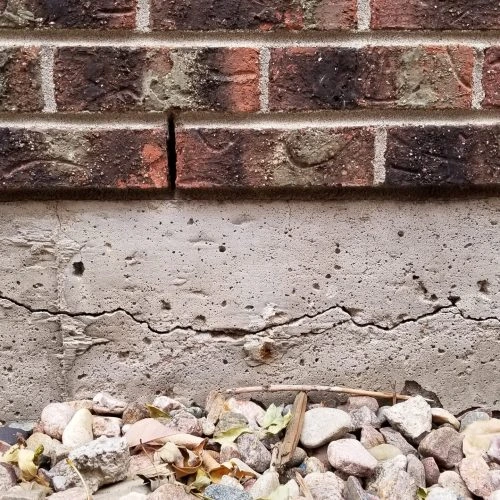
Push Piers: Hydraulically Driven Underpinning for Settling Foundations
Steel push piers (resistance piers) are hydraulically driven through unstable soil to load-bearing strata, then locked off to permanently arrest settlement and, where conditions allow, lift the structure back toward grade.
Free inspection • Exact price in writing • 0% financing on approved credit
Quick Answer
Push piers are end-bearing steel underpinning. We drive 2-7/8 in. or 3-1/2 in. seamless steel tubes vertically through soft soil using your structure's own weight as resistance, terminate them on competent strata, and transfer the foundation load through engineered brackets. They are the right call for heavy structures, deep fill, or sites where helical torque-to-capacity correlation isn't reliable.
A push pier is a deep-foundation underpinning element installed without rotation, excavation under the footing, or new concrete. A bracket is fastened to the side of the existing footing, and seamless steel pipe sections are pressed downward through the bracket with a hydraulic ram. The reaction force is the weight of the structure itself: each pier is advanced only until the soil around it can no longer resist further movement, which by definition means the pier has found a stratum capable of carrying the load.
Once every pier on the structure has reached refusal, the system is staged for either stabilization-only or lift. Synchronized hydraulic jacks at every bracket allow our crew to attempt restoration of elevation in small, monitored increments. The amount of recoverable lift depends on how brittle the foundation has become, the wall's ability to act as a beam, finish materials inside, and whether utilities can tolerate movement. Stabilization is always achievable when the system is properly designed; lift is a goal, not a guarantee.
Along Colorado's Front Range, push piers are frequently the preferred system on older masonry foundations and two-story homes where loads exceed practical helical capacities, on sites with deep fill from cut-and-fill grading, and on properties where bentonite-bearing claystone (Pierre Shale) heaves and shrinks seasonally above more competent bedrock. Because final capacity is verified pier-by-pier against the actual structure during installation, push piers carry less interpretation risk than designs that rely solely on pre-construction soil borings.
How a Push Pier Carries Load
A push pier is an end-bearing element. The load path runs from the footing, into a steel underpinning bracket bolted and shimmed against the footing's vertical face, down through a stack of steel pipe sections joined by external sleeves, and finally into a stratum stiff enough that the pipe stops advancing under the available reaction load. Skin friction along the pipe wall is not relied on for design capacity; that is the key difference between a push pier and a friction pile.
Because the structure's dead weight is the only available reaction during installation, every push pier passes a real-time load test as it is being driven. A pier that takes load to the specified factor of safety against the building's weight is, by inspection, capable of carrying the share of structure assigned to it.
Materials & Typical Specifications
- Pipe: seamless or ERW steel, commonly 2-7/8 in. or 3-1/2 in. O.D., wall thickness 0.165–0.262 in., grade per ASTM A500 or A53.
- Coating: hot-dip galvanized per ASTM A123, or epoxy/zinc-primer coatings where soils are aggressive.
- Brackets: heavy-plate steel with bolt-on retrofit ear, designed for the specific footing geometry; lift heads add a vertical jacking surface.
- Working capacities: typical residential designs target 25–55 kips per pier with a factor of safety of 1.5 against the maximum installation force.
- Pier spacing: determined by tributary wall load — commonly 5–8 ft on residential perimeter foundations.
All values are typical for residential underpinning along the Front Range. Final pipe size, spacing, and capacity are set by the project engineer based on wall loads and observed driving behavior.
Installation Sequence
- 1. Engineering & layout. A licensed PE reviews loads, soils data when available, and the failure mode (settlement vs. heave vs. fill movement) before issuing a sealed pier layout.
- 2. Excavation at each bracket. A roughly 3 ft × 3 ft × 3 ft pit is hand-dug at each pier location to expose the footing face. Landscaping and hardscape are protected and replaced.
- 3. Footing preparation. The footing corner is notched if required and the bracket is dry-fit, ensuring full bearing on the vertical face.
- 4. Pier driving. Steel pipe is pressed through the bracket in 3–4 ft sections with a hydraulic ram until the design force is held for a sustained interval — the refusal criterion.
- 5. Cap, transfer, and lift. A lift head is installed on each pier. Jacks across all piers are pressurized in unison to transfer load. Where the structure can tolerate it, elevation is recovered in 1/16 in. increments while the crew monitors finishes.
- 6. Lock-off & documentation. Piers are mechanically locked to the brackets, jacks are released, and the system carries the load. Driving pressures and final lift readings are recorded for the engineering report.
- 7. Backfill & restoration. Pits are backfilled in lifts and surface finishes restored.
Push Piers vs. Helical Piers vs. Wall Anchors
| Decision factor | Push pier | Helical pier | Wall anchor |
|---|---|---|---|
| Failure type | Vertical settlement | Vertical settlement, light loads | Lateral bowing |
| Load proof | Real-time, structure-tested | Torque-to-capacity correlation | Tightening schedule |
| Best for heavy structures | Yes — preferred | Limited by torque rating | N/A (lateral only) |
| Lift potential | High — synchronized jacks | Moderate | N/A |
| Tight access / new build | Possible | Preferred | N/A |
Why Push Piers Fit Colorado Soils
The Front Range corridor is dominated by expansive bentonitic claystone of the Pierre Shale and Denver formations, layered with alluvial fill in valleys and decomposed granite around Monument and the Palmer Divide. These soils swell and shrink with seasonal moisture, producing both settlement and heave. Push piers solve the vertical-settlement case because they are driven through the active zone — typically the upper 10–20 ft — until the pipe finds a layer stiff enough to resist the building's weight. The depth at which refusal occurs is not predetermined; it's discovered pier-by-pier, which is the right approach when stratigraphy varies wildly across a single lot.
Where the dominant problem is heave (slab lifting after irrigation, post-tensioned slabs domed in the middle), piers alone don't solve the problem — moisture management and, in some cases, void boxes or compressible fill are also required. We'll tell you when piers are the wrong tool.
Lifespan & Maintenance
Galvanized steel push piers installed in non-aggressive soils have a service life measured in decades and are typically considered permanent for residential structures. The system requires no scheduled maintenance. What you should maintain is the moisture envelope around the foundation: positive drainage at 5% over the first 10 ft, properly extended downspouts, irrigation that is consistent rather than feast-or-famine, and the absence of large water-seeking trees within their mature root radius of the wall.
What Drives the Cost
- • Number of piers (function of wall loads and length of distressed area)
- • Depth to refusal — deeper drives consume more pipe and more time
- • Access — basements, finished interiors, and tight side yards take longer
- • Lift attempt vs. stabilize-only
- • Permitting, engineering, and any required interior shoring
- • Restoration of landscaping, hardscape, or interior finishes
Every job is quoted after an on-site evaluation. We don't publish per-pier pricing because pier count and depth aren't knowable until we've seen the structure.
Worried about what you're seeing? Get a free inspection and an exact price in writing, with no pressure and no obligation.
Key Benefits
- End-bearing capacity verified pier-by-pier during installation
- Hydraulic lift attempt with synchronized jacks across all brackets
- Galvanized seamless steel, designed by a Colorado PE
- Installed from the exterior without pouring new concrete
- Independent engineering documentation provided on completion
- Compatible with masonry, poured-wall, and ICF foundations
Frequently Asked Questions
Don't Wait Until Small Cracks Become Major Structural Repairs
Call Today! (719) 497-1388
0% financing available • Lifetime transferable warranty on piers & waterproofing • 5% military & first responder discount